Conference Report: “Jews and the Worlds of the Ancient Mediterranean: Archaeology, Scholarship, and Networks of Collecting (c.1840–1940)”
In July 2026, a two-day conference on “Jews and the Worlds of the Ancient Mediterranean: Archaeology, Scholarship, and Networks of Collecting (c.1840–1940)” was held at the Palazzo Butera in Palermo. Silvia Davoli (Strawberry Hill House/University of Oxford) and Tom Stammers (Courtauld Institute) convened the event with support from the John Fell Fund at the University of Oxford; La Fondazione per il Museo Ebraico di Roma; the Palazzo Butera; UCEI – Unione delle Comunità Ebraiche Italiane; Brasenose College; and the Centre for the Study of the Bible, Oriel College. The conference gathered historians, archaeologists, philologists, literary and biblical scholars, curators and community representatives from across Europe, Israel and the United States.
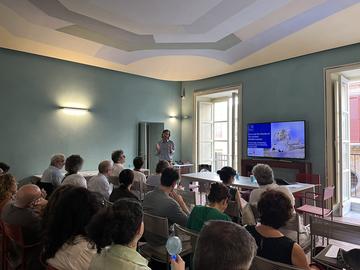
Claudio Gulli welcomes the delegates at the Palazzo Butera
In their introductory remarks, Claudio Gulli, Silvia Davoli, Tom Stammers and Abigail Green framed the two days around three core areas of inquiry: (1) the relationship between Judaism and the Greco-Roman world, and the need to expand that story beyond the familiar German tradition — with Palermo itself offering a distinctively Mediterranean vantage point; (2) the dual place of Jews in archaeology, at once practitioners and objects of inquiry, caught between religious and scientific motivations and between “classical” and “Oriental” archaeology; and (3) the “dialectic of the antiquities rush” — archaeology in the age of imperialism and the ambivalent position Jews occupied within it.
The keynotes spread throughout the event articulated the contours of the discussion. In her opening address, Suzanne Marchand (Louisiana State University) deliberately “enlarged the canvas” by turning to an antiquity that was neither classical nor biblical: the “Euro-barbarian” or Scythian past, cultivated from Herodotus to the nineteenth century by resentful, nativist “men of the land” in opposition to the cosmopolitan “men of the cabinet” — a tradition from which Jews were strikingly absent, and whose anti-elitist and often antisemitic energies have long afterlives. Later Hindy Najman (University of Oxford) and Paul Collins (British Museum) reflected on “the fragment as method”, bringing philology and curatorial practice into dialogue. The address encouraged schoalrs to consider the “fragment” as both an object and framework of inquiry in a move otwards a dynamic and vital study of the near and distant past. Steven Fine (Yeshiva University) opened the second day of the conference with a sweeping overview of the durable myth that “Jews don’t do art”, tracing this dehumanising trope through the Jewish Encyclopedia and the long interpretive battle over the Arch of Titus menorah. Finally, Giuseppe Mandalà (Università Statale di Milano) turned the conversation locally to Sicily asking who owns the past of a community that no longer exists. In her presentation she demonstrated how, from the eighteenth century onwards, Sicilian intellectuals came to speak of gli antichi nostri ebrei — “our ancient Jews” — so that the history of Sicily’s vanished Jews became part of how Sicily learned to remember itself.
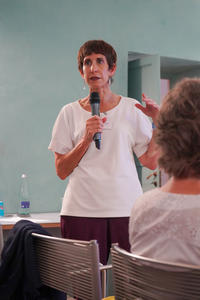
Miriam Goldstein, Hebrew University of Jerusalem
Between keynote addresses, the various panels dove into detailed case studies of the conference’s larger themes. Several panels explored Jews as collectors and mediators of antiquity. Papers on Ferdinand de Rothschild (Colette Bellingham), the Mieli-Servadio collection in Tuscany (Anna Di Castro), archaeological donations by Jews in Liberal Italy (Luisa Levi D’Ancona Modena), and Freud, Loewy and Pollak in wartime Vienna (Orietta Rossini) situated Jewish collecting within family, civic and scholarly networks. The ambiguities of such mediation emerged most sharply in Miriam Goldstein’s (Hebrew University of Jerusalem) reassessment of Abraham Firkowicz—a Karaite writer, archaeologist, and collector—whose 15,000-codex collection in St Petersburg remains foundational for Jewish studies. Firkowicz’s seemingly incongruous dual identity as collector and forger, Goldstein argued, were one man pursuing a single end: gathering an ancient Karaite past where evidence survived and manufacturing it where it did not. Related questions of scholarly identity and ideology ran through papers on the Egyptian-Jewish Egyptologist Joseph Leibovitch (Thomas Gertzen), Isaiah Sonne and the Cairo Genizah (Martina Mampieri), and Jocelyn Burney’s (University of Missouri) portrait of Belle Mazur, the amateur American archaeologist of the Aegina synagogue, who read the ancient diaspora through the Jewish crises of her own present.
Other sessions turned to the imaginative and artistic uses of the ancient past. Nora Goldschmidt (Durham University) read Shaul Tchernichovsky’s “imaginary archaeology” as a refusal of the Jew-versus-Greek binary; Giacomo Loi (University of Haifa/Sorbonne Nouvelle) introduced Hebrew “archaeo-fiction”, from Lamdan’s Masada to Livne’s Over the Ruins, as the popular foundation of archaeology in the Yishuv; and Hemdat Kislev (Hebrew University of Jerusalem) compared Melnikov’s Roaring Lion at Tel Hai with Eric Gill’s reliefs for the Palestine Archaeological Museum — two primitivist monuments of 1934 serving opposed national imaginations. Papers by Germano Maifreda on photographic mapping of Jewish monuments under Fascism and by Santino Alessandro Cugno and Jessica Dello Russo on the ‘kokh’ tombs of Rome extended these questions to the politics of documentation.
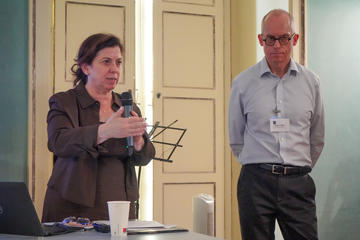
Hindy Najman, University of Oxford, and Paul Collins, the British Museum
Fittingly, the conference closed with a focus on Sicily. A reflection by Giulio Disegni (UCEI) on Jewish life in Southern Italy today announced that the Archdiocese of Palermo has granted the ancient Oratorio di Santa Maria del Sabato to the city’s Jewish section as its future synagogue and insisted that “memory must become life”. A final panel on Jewish Sicily — Gianfranco Ferlisi on archives and genealogies, Francesco Melia on archaeology and philology in 1920s Palermo, Anastazja Buttitta on the forgotten Jewish past of Pantelleria — was framed by Claudio Gulli’s tour of the Palazzo Butera and a visit to the Museo Archeologico Regionale Antonino Salinas.
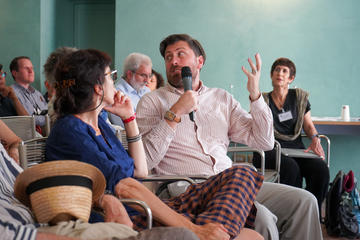
Tom Stammers, Courtauld Institute
Across two days, the discussions moved from Scythian burial mounds to Genizah fragments, from the Arch of Titus to Hebrew poetry, everywhere probing how the ancient Mediterranean was collected, forged, displayed and mobilised — and by whom. Warm thanks are due to the convenors, to the team at Palazzo Butera for their extraordinary hospitality, and to all the delegates for two days of rich and generous exchange.
Edward Maza
PhD Candidate - Medieval Art & Archaelogy, Princeton University

