
Dutch Jewish Country Houses as Applied Heritage Sites
From 26-29 October 2026, the international conference “Applied Heritage: Research and Practice of Jewish Heritage” took place in Amsterdam, an initiative of the German DFG Priority Programme Jüdisches Kulturerbe in collaboration with the University of Amsterdam and Jewish Social Work (JMW). A diverse group of heritage professionals, scholars, educators, and community representatives exchanged approaches to the preservation and interpretation of Jewish heritage and its translation to different audiences.
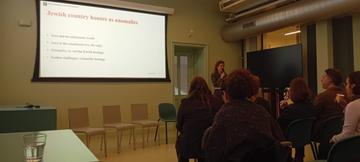
Affiliated researcher to the Jewish Country Houses project Dr. Sietske van der Veen (University of Amsterdam) presented a paper entitled “Jewish Country Houses as Applied Heritage Sites: The Dutch Case.” In her presentation, she argued that former Jewish-owned country homes are treasure troves of stories, about among other things space-making, belonging – to the land and to the nation –, class, family, the negotiation between tradition and modernity, and the tension between power and vulnerability. This particular kind of Jewish heritage should be better integrated into wider Jewish and general heritage narratives, in the Netherlands as elsewhere, as country houses urge heritage professionals and the wider public alike to think beyond conventional (Jewish) heritage boundaries.
The Dutch case study is particularly interesting because of the country’s unique long history of Jewish landownership, dating back to the early modern period. After outlining a short history of Dutch Jewish country house ownership, Sietske highlighted the different destinies of these sites in the post-World War II period, ranging from demolition to sale and from repurposing as offices, hotels, event locations, schools, and apartments to, albeit rarely, musealisation. She concluded her paper with a number of ideas on how to make the histories of these houses more visible to a wider audience, mentioning best practices of the Jewish Country Houses project such as educational training sessions and pop-up (travelling) exhibitions, as well as, among other things, inclusion in hiking and cycling tours, podcasts, and the further incorporation of these sites into existing initiatives such as Open Joodse Huizen (“Open Jewish Homes”) and the European Days of Jewish Culture.

