Call for Papers - “Mixed” Marriages? Debates and Discourses around Endogamy and Exogamy in Jewish History
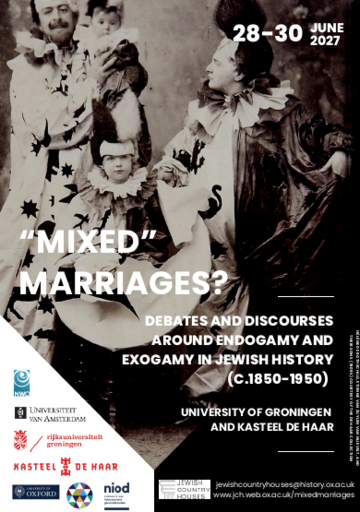
Call for Papers | “Mixed” Marriages? Debates and Discourses around Endogamy and Exogamy in Jewish History (c. 1850-1950)
28-30 June 2027 | University of Groningen and Kasteel de Haar
Convened by Dr. Sasha Goldstein-Sabbah (University of Groningen), Dr. Laurien Vastenhout (NIOD Institute for War, Holocaust and Genocide Studies), and Dr. Sietske van der Veen (University of Amsterdam)
Conference Description
Organised as part of the Jewish Country Houses & their Worlds project — the international and interdisciplinary initiative exploring Jewish country houses as sites of European memory, mobility, and cultural exchange — this conference examines the role of marriage, kinship, and intimacy in shaping Jewish social worlds in the modern period. It seeks to reconsider marriage not merely as a private or communal institution, but as a key mechanism through which Jews navigated religious affiliation, class, cosmopolitanism, social aspiration, political allegiance, kinship and family networks, cultural belonging, notions of empire and processes of inclusion and exclusion across Europe, the Middle East, North Africa, and beyond. Marriage alliances often functioned as vehicles for mobility, integration, diplomacy, economic strategy, and the consolidation — or disruption — of transnational Jewish networks. At the same time, they exposed tensions around communal boundaries, religious continuity and traditions, gender norms, and racialised understandings of identity within both Jewish and non-Jewish societies.
Endogamy — the practice of marrying within one’s own religious, ethnic, or social group — has long been a defining feature of Jewish communal life. Historically, Jewish marriage patterns often reflected not only religious boundaries, but also distinctions of class, geography, language, and communal affiliation, including divisions between Ashkenazi, Sephardi, and other Jewish subgroups. Yet exogamy, or “marrying out,” has always existed within Jewish societies, becoming increasingly visible and socially consequential in the nineteenth and early twentieth centuries in the context of emancipation, secularisation, urbanisation, socio-economic mobility, imperial expansion, colonial encounters, and the emergence of modern nationalism.
What did “mixed” relationships – whether or not institutionalised in marriage – signify in different Jewish contexts? How were such unions understood within Jewish communities, by wider society, and by state authorities? How did individuals and families navigate the complexities of love, kinship, and belonging? To what extent were marriages instruments of social mobility, cosmopolitan aspiration, political alliance, survival, or assimilation? How did imperial structures, colonial encounters, and transnational commercial and philanthropic networks shape marital strategies and notions of communal identity and belonging? What are the heuristic possibilities — and limitations — of the category of “mixed marriage” itself?
This conference seeks to explore the debates, anxieties, lived experiences, and historiographical questions surrounding endogamy and exogamy in modern Jewish history, particularly — though not exclusively — among Jewish elites and across imperial, colonial and transnational settings. Rather than situating Jewish marriage patterns solely within nationally bounded bourgeois cultures, the conference encourages approaches that foreground mobility, empire, diaspora, global Jewish networks, Jewish/non-Jewish relations, and intra-Jewish social hierarchies.
We welcome scholarship examining not only Jewish/non-Jewish unions, but also relationships across Jewish communal, ethnic, linguistic, racial, and class boundaries, as well as same-sex unions and other intimate relationships that challenged communal norms. Particular attention will be given to the role of marriage in connecting Jewish communities across and beyond Europe, including the, the Middle East, North Africa, India, and other imperial and diasporic spaces, and to the ways these relationships complicate conventional narratives of assimilation, emancipation, and modernity.
In studying “unorthodox” unions, the conference aims to reconsider marriage not merely as a private or communal institution, but as a key site through which questions of identity, inclusion and exclusion, family networks, citizenship, social aspiration, cultural belonging and political loyalty were negotiated in the modern world.
The conference will also address the methodological and ethical challenges of interpreting and presenting these histories within museums, archives, and heritage institutions. “Mixed” relationships often remain emotionally sensitive subjects for descendants, curators, and communities alike. Dedicated panels in partnership with heritage institutions will therefore consider how academics and heritage professionals can navigate questions of privacy, memory, representation, and historical accuracy when interpreting intimate histories.
We invite contributions from scholars and heritage professionals working in history, Jewish studies, sociology, anthropology, literature, art history, gender and sexuality studies, museum and heritage studies, Middle Eastern studies, imperial and colonial history, migration studies, and related disciplines.
Possible themes include, but are not limited to:
-
Jewish/non-Jewish marriages and partnerships
-
Marriage across Jewish subgroups
-
Intersections of class, wealth, and marriage strategy
-
Marriage, conversion, and religious identity
-
Marriage, citizenship, and legal status
-
Race, racialisation, and “mixedness” in Jewish history
-
Same-sex unions and queer Jewish histories
-
Marriage and imperial or colonial networks
-
“Mixed” relationships as a strategy of survival, mobility, diplomacy, or integration
-
Endogamy and intra-Jewish hierarchies
-
Cosmopolitanism, transnationalism, and elite family networks
-
Gendered dimensions of relationships and social expectation
-
Love, emotion, and affect in Jewish family history
-
Kinship networks and transnational family strategies
-
Interfaith families and questions of inheritance, lineage, and belonging
-
Marriage and philanthropy within global Jewish networks
-
Representations of mixed marriages in literature, art, and popular culture
-
Heritage, curation, and the ethics of interpreting intimate family histories
-
Jewish country houses and the role of marriage in shaping dynastic and transnational networks
-
Curation, preservation, and public history within the context of the conference theme
Accommodation (2 nights in Groningen), meals, and transportation from Groningen to Kasteel de Haar will be provided by the conference organisers.
In case your institution does not cover travel expenses, the organisers will endeavour to provide a limited number of travel grants.
Please submit your proposal with title, abstract of no more than 300 words, and a short bio/CV in one PDF/document by email to jewishcountryhouses@history.ox.ac.uk by 31 October, 2026.
University of Groningen, Kasteel de Haar, University of Amsterdam, NWO (Dutch Research Council, NIOD (Institute for War, Holocaust and Genocide Studies), University of Oxford. Groningen Synagogue.
Download the full Call for Papers here.


